Linked Issue Listeners provide field synchronization between Jira issues that are connected via standard Jira issue links (such as Blocks, Relates to, or Clones).
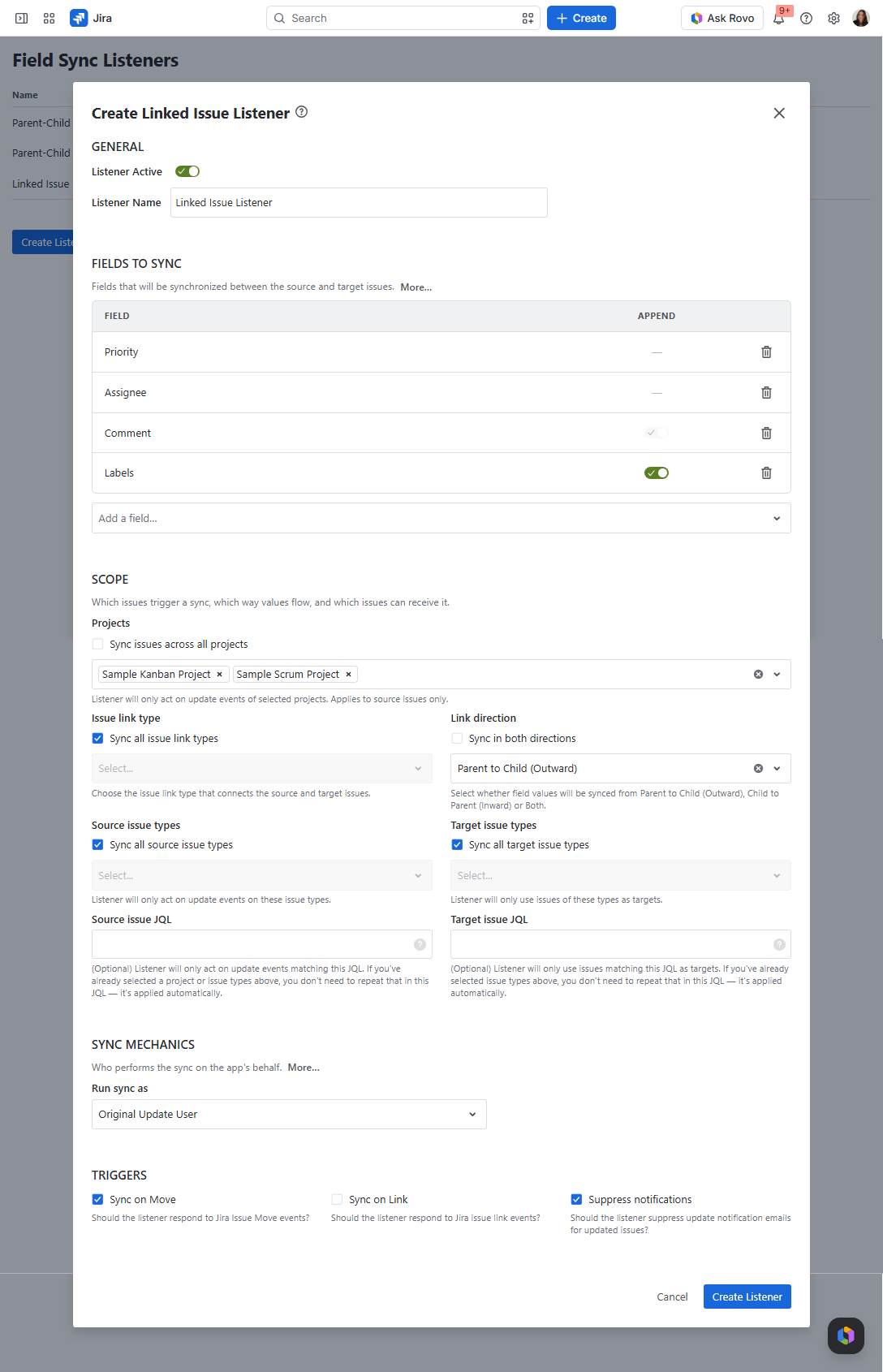
A sample Linked Issue Listener's Configuration page is shown below.
General
Listener Active
This switch is enabled by default when creating a listener. Turn it off to disable the listener. When disabled, the listener will not respond to changes in any issues.
Listener Name
Enter a unique and descriptive name to identify the listener.
Fields to Sync
Select fields that will be synchronized between the source and target issues. Both system and custom fields are supported.
Field Sync copies field values between issues without resolving to contents of the field. Some complex custom field types introduced by plugins might not be compatible with simple value copy.
Append
The Append option determines how source field values are applied to target issues.
-
Selected: Source field values are added to the existing values in the target issue.
-
Not selected: Target issue field values are replaced with the source issue's values.
This option is available for supported multi-select system fields and built-in custom field types. Custom field types provided by other apps are not yet supported.
Scope
Projects
Choose which Jira projects the listener will monitor for update events:
-
Sync issues across all projects: Check this box to enable monitoring across all Jira projects in your instance.
-
Specific Project Selection: To limit monitoring to specific projects instead, leave Sync issues across all projects unchecked and select your target projects from the dropdown menu. The listener will only respond to update events occurring on source issues within these selected projects.
Issue link type
Choose issue link types that the listener will follow on source issue when finding target issues.
-
Sync all issue link types: Check this box to enable synchronization across all Jira issue link types.
-
Specific Issue Link Type Selection: To limit synchronization to specific issue link types instead, leave Sync all issue link types unchecked and select your preferred link types from the dropdown menu (such as Blocks, Clones, or Relates to).
Link direction
Choose the link type direction that the listener will follow on source issue when finding target issues.
-
Sync in both directions: Check this box to enable bi-directional synchronization. Field value updates on source issues will sync to target issues, and updates on target issues will sync back to source issues.
-
Single Direction Selection: To sync values in only one direction instead, leave Sync in both directions unchecked and select your preferred flow from the dropdown menu:
-
-
Outward (Parent to Child): Field values will sync from source issues to target issues via outward links (such as blocks, clones, or causes).
-
Inward (Child to Parent): Field values will sync from target issues to source issues via inward links (such as is blocked by, is cloned by, or is caused by).
-
-
-
Source Issue Types
Select issue types that can trigger a sync event on the source side:
-
Sync all source issue types: Check this box to allow all issue types to trigger update events.
-
Specific Source Issue Type Selection: To limit triggers to specific issue types instead, leave Sync all source issue types unchecked and select target types from the dropdown menu. The listener will only act on update events occurring on these specified issue types.
Target Issue Types
Select issue types that can receive synced values on the target side:
-
Sync all target issue types: Check this box to allow all issue types to be updated as targets.
-
Specific Target Issue Type Selection: To limit targets to specific issue types instead, leave Sync all target issue types unchecked and select target types from the menu. The listener will only use issues matching these selected types as targets.
Source Issue JQL (Optional)
Source issue is the issue that the update is made on and the event is fired on.
If entered, the listener will only act on events on issues that match the given JQL.
Since any valid JQL can be used, Source Issue JQL setting provides great flexibility to filter source issues.
Target Issue JQL (Optional)
Target issues are the issues that are linked to the source issue with one of the selected link types.
If entered, the listener will only sync values to issues that match the given JQL.
Since any valid JQL can be used, Target Issue JQL setting provides great flexibility to filter target issues.
SYNC MECHANICS
Choose who performs the sync on the app's behalf:
Run Sync As
Select the identity Field Sync will use to update target issues:
-
Original Update User: Target issues are updated using the account of the user who made the change to the source issue.
-
Service User: Target issues are updated using the selected Service User account. This option is useful when the user who updates the source issue does not have permission to view or edit the target issue. The target issue history will show the Service User as the one who made the update.
-
Field Sync App: Target issues are updated using the Field Sync app's identity, allowing synchronization even when the user who updates the source issue does not have edit permission on the target issue.
TRIGGERS
Configure additional event triggers and behavior settings:
-
Sync on Move: If selected, field values will be synced between linked issues according to sync direction when an issue is moved from one project to another (If the sync direction is Bidirectional, syncs values in the Inward direction). If not selected, listener will not respond to move events but sync might still occur since an update event might also be fired if fields are updated in the process.
-
Sync on Link: If selected, field values will be synced between issues according to sync direction when issues are first linked. If not selected, the listener will not respond to link events.
-
Suppress Notifications: Check this box to prevent notification emails from being sent to users watching the updated target issues. For this option to work, the user executing the sync must be a Jira administrator or the Field Sync app. If Service User is selected, the configured account must have Jira administrator permissions. Notification suppression is not guaranteed when Original Update User is selected.
Note: In team-managed projects, Field Sync cannot view issues restricted with the Restrict to field, so changes on these issues do not trigger listeners. If you want Field Sync to view and synchronize restricted issues, the only option for now is to add the Field Sync app user to the relevant project roles using the Jira REST API. Atlassian does not allow this from the Jira UI.
To add the app user to a project role, send the following request:
POST /rest/api/3/project/{projectKey}/role/{roleId}
{"user": ["<Field Sync app accountId>"]}
The same limitation applies to restricted issues in company-managed projects. In company-managed projects, however, access can be granted to the Field Sync app user from the Jira UI.